

How to use your Greenland paddle
When paddling with a Greenland paddle for the first time, you will find that moving forward is about more than just brute strength. It is all about precision.
The right technique is crucial for the sensation of moving forward without using unnecessary strength and for your overall paddling experience.
Therefore, on this page, I will provide you with inspiration on how to get off to a good start using your Greenland paddle. If you want to read a detailed description of how to use the paddle correctly, I highly recommend Björn Thomasson’s guide.
Keep the paddle at the right angle
Hold the paddle with elbows bent so your forearm is parallel to the deck. When you take a stroke with your Greenlandic paddle, the oval handle ensures that the top edge of the paddle points 10-15 degrees forward. This has the advantage that you avoid wobbling and the blade enters and exits the water silently.
You also get the optimal angle when your rooftop – from lifting and loading to lifting again – forms a flat oval when viewed from the side.

Your first paddle stroke
If your paddle has a round and a flat side, start by using the round side.
When you’re ready for a rowing stroke, insert the blade as far forward as you can reach. And now, with a restrained but firm grip, you pull as far back as you can. At the same time, rotate your torso so that the shoulder axis is parallel to the paddle handle. That way you can make full use of your muscle power.
When the paddle is fully back, put the opposite blade in the water as far forward as possible and repeat the process.
Footwork
All the power from your stroke should be channeled into the foot on the side you are rowing. This way, you transfer the power to your kayak via the footrest and get a smooth, forward motion.
When you first start rowing with a Greenlandic paddle, you’ll find yourself rowing at a higher cadence. Once you’ve rowed a few kilometers – and once you get used to the paddle and concentrate on your rowing position and technique – you’ll find that you’ll get better and better at getting the paddle to stay still in the water.
Your cadence will be almost the same as a regular paddle or a wing paddle.
When you’re comfortable with your paddle
Now you’re about to use the flat side. You do exactly the same as when using the round side, but you now have so much control over the paddle that its slightly different motion in the water won’t cause you any problems. The flat side gives you a bit more power and a change of rhythm when you switch between the two sides.
After a few hours of rowing, you can start experimenting with how much extra power you can transfer to the paddle without making a sound. You may need to change the angle of your grip slightly – this is where fine-tuning comes in.
When you row silently and without causing much disturbance in the water, you’ve found the trick.

Avoid wasting your power when rowing
I often find that a lot of rowers spend unnecessary effort on rowing without getting there faster. They simply move too much water and forget that a kayak is sluggish.
Most kayaks have a theoretical maximum speed of 10-15 kilometers per hour. In practice, most people row at 4-7 kilometers per hour – depending on the length of the kayak, wind, current, waves and the rower’s strength, energy and mood.
Since the kayak can’t accelerate like an Italian sports car, it’s not worth trying to make the kayak sprint forward.
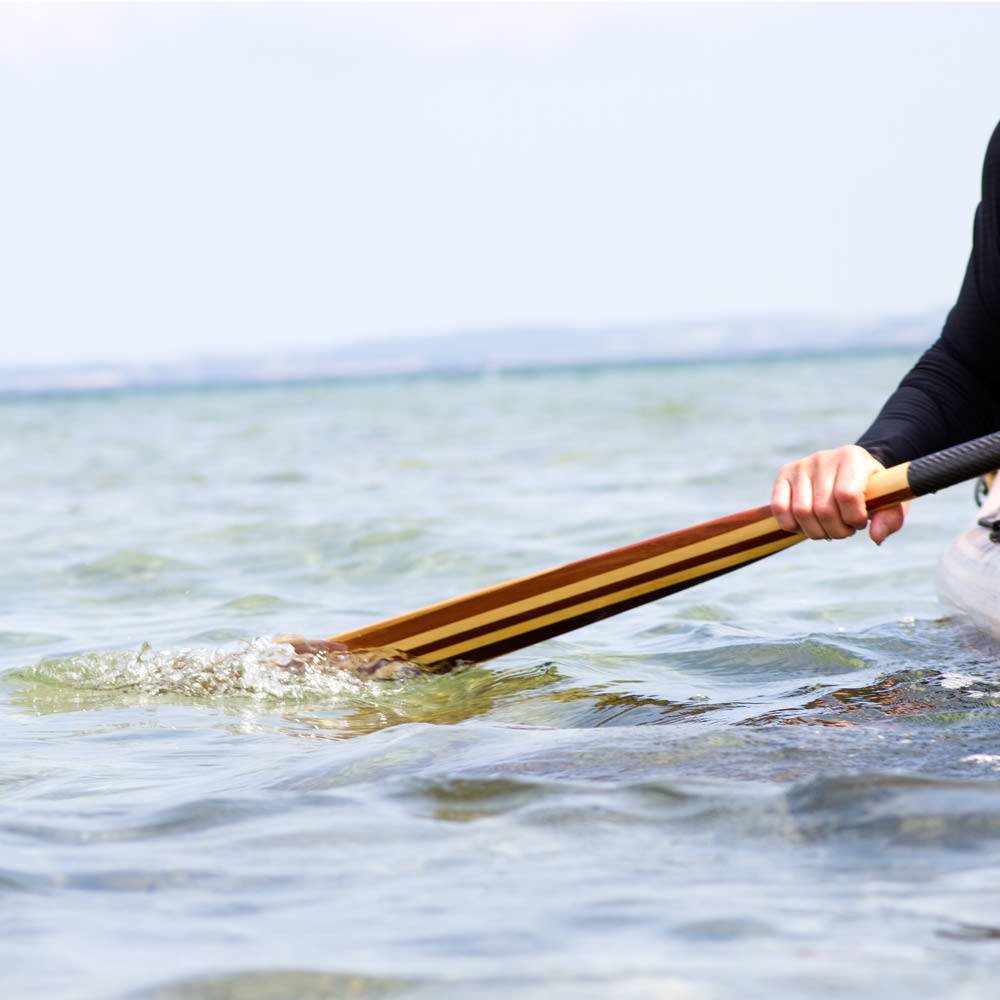
Not sure if you're using too much effort?
Then try looking at the tip of your paddle. Does it form a hole in the water? Danner den mange hvirvler og skum? Or do you find that your paddle bends a lot and is unsteady during rowing? This could be a sign that you’re wasting your energy.
It requires peace of mind and body when you’re rowing your kayak. At least if you want to row far without getting cold. This is where the Greenlandic paddle shows its strength. A regular paddle has too large an area too far away from the centerline of the kayak. It’s easy for a rower to spend unnecessary effort moving water and creating eddies.
The Greenlandic paddle, on the other hand, has its working area distributed evenly over most of its length. This gives the rower a calm experience at the same speed. If you want to speed up, it’s all about accelerating at a slow and steady pace without effort, splashing and splashing. You’ll reach your goal in the same amount of time and less exhausted.